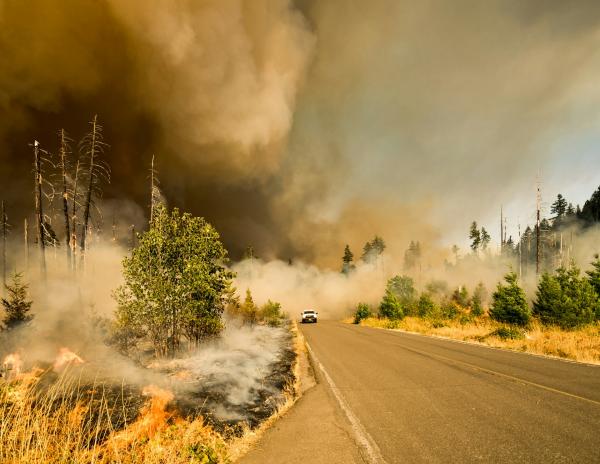
A new study from the University of California, Santa Barbara and UC Cooperative Extension has identified a critical threshold for wildfire survival: communities with fewer than six roads out face a dramatically higher risk of fatalities during a wildfire. The research, published in the Proceedings of the National Academy of Sciences, analyzed 342 wildfire deaths across the United States between 2008 and 2024, creating the most comprehensive georeferenced fatality dataset to date.
The study found that fatalities drop sharply as communities gain more outward road access, but only up to about six exits. Beyond that, additional roads offer little extra protection.
This pattern held consistently across different geographies and community sizes, indicating a structural constraint rather than a demographic one. Lead author Caitlin Fong, a researcher at UCSB’s National Center for Ecological Analysis and Synthesis, said, "Road redundancy is what saves lives."
The research highlights devastating examples. In the 2018 Camp Fire, 66 of 86 total fatalities occurred in Paradise, Butte County—a town with six outward roads that offered limited functional redundancy as fire and gridlock converged.
In the same county, 13 people were killed in Berry Creek, a community with only two exits, during the 2020 North Complex Fire. In 2023, 102 people died in Lahaina, Hawai'i, a town with just four exit routes.
Nationally, the team combined egress data for every U.S. community under 50,000 residents with wildfire hazard maps and census population counts.
They found that 17.7 million people live in communities below the critical six-exit threshold, with 5 million of those in areas that also face high wildfire hazard. Additionally, 528 communities, typically small and remote, have no major road exits at all, spread across 41 states.
High-risk hotspots exist not only in the West but also in Oklahoma, Florida, and Hawai'i—states not typically central to national wildfire policy.
"These maps show where wildfire has been deadly in the past," Fong said. "Climate change means the future will look different.
Places that have never had to think about evacuation routes are going to have to start." The researchers emphasize that early evacuation is crucial. "Being prepared with a go bag and leaving as soon as possible can help reduce road congestion during evacuation," said co-author Max A.
Moritz, UC Cooperative Extension statewide wildfire specialist.
The scientists created an interactive map showing the vulnerability of communities across the U.S. based on the number of roads available for evacuation and wildfire hazard.
Moritz noted, "There are 17 million Americans living in communities that, by this measure, are not designed to survive a fast-moving wildfire. That should be a wake-up call—not just for California, but for every state that thinks wildfire isn’t their problem yet."
The study points to three complementary approaches: expanding egress infrastructure where feasible, improving early warning systems and evacuation behavior, and investing in pre-planned shelter-in-place options like temporary refuge areas—such as wide parking lots, ball fields, and other open areas—for when evacuation fails. Moritz hopes policymakers and city planners consider these recommendations.
"We can design new communities to be safer, paying more attention to ingress for fire suppression and egress for evacuation needs related to wildfire," he said. "Because changing the road network of existing communities tends to be difficult and expensive, vulnerable areas need to have much better training, education and planning related to evacuation."